Definition and scope
Carving creates form through the controlled removal of wood. This distinguishes it from additive processes such as modelling. Wood carving includes sculpture in the round, relief and ornamental surfaces. Woodcut is a separate printmaking process: a block is cut so that the raised areas can be inked and printed. Turning is also distinct because the workpiece rotates around an axis while it is shaped.
From design to form
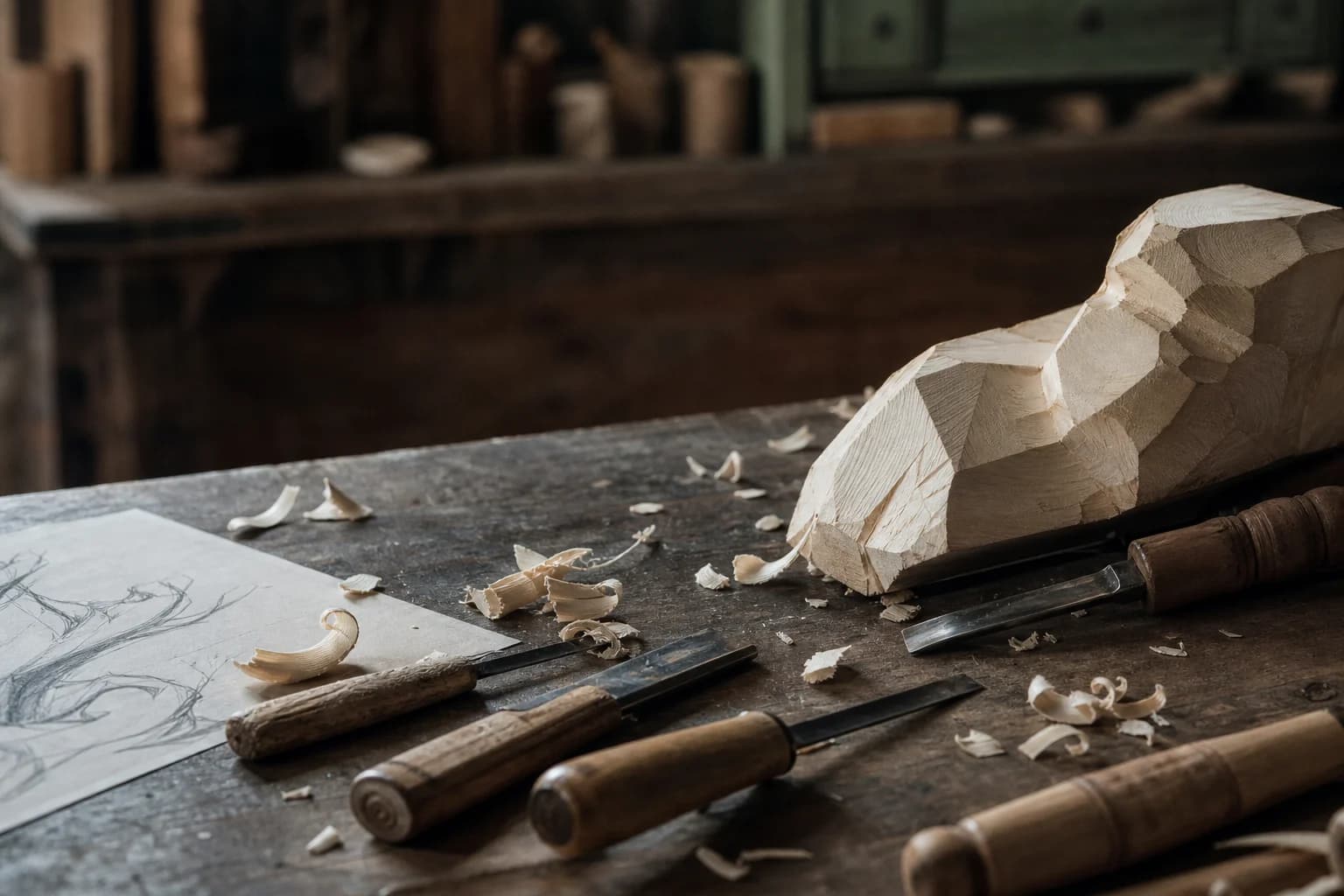
A work may be prepared with drawings, templates or a three-dimensional model; in direct carving, the form develops from the wood without a detailed model. After selecting and orienting the piece, the basic mass is roughed out before volumes, transitions and details are refined. Removed material cannot simply be replaced, so grain direction, proportion and the order of cuts are essential.
Timber and material behaviour
Suitability does not depend only on whether a species is botanically classed as a hardwood or softwood. Density, grain, pores, knots, moisture and drying affect both carving and durability. Evenly grown timber often supports fine detail, while coarse or changing grain may encourage a stronger surface. Lime, oak, walnut, pine, stone pine and cedar are examples, not a universal ranking. Selection depends on scale, location, finish and intended expression.
Tools and cuts
Common hand tools include carving knives, straight and curved gouges, V-tools, chisels and mallets. Axes, adzes or saws may be used to establish larger forms. Sharpness and controlled handling matter more than owning many tools. Cutting with, across or carefully against the grain creates different surfaces and different risks of splitting. Visible tool marks may remain part of the design.
Figure, relief, ornament and object
A free-standing sculpture is shaped from several sides. In relief, the image remains connected to a background and gains space through shallow or deep carving. Ornamental carving structures furniture, architecture, vessels and functional objects. Masks, signs, toys, sacred works and abstract sculpture also belong to the field. Their meaning and use vary with cultural and historical context.
Surface and finish
After carving, a surface may remain rough or tool-marked, or be smoothed, sanded, painted, stained, oiled, waxed, lacquered or gilded. A polychrome wooden sculpture is not merely decorated timber: ground layers, paint and metal leaf may be integral to the original design. Cleaning and later treatment should therefore consider the material, age and surviving layers.
Conservation and care
Wood responds to changes in humidity and temperature. Strong fluctuations can contribute to warping, cracks or loose painted layers; light, pests and unsuitable cleaning cause further damage. Unfinished wood should not routinely be wet-cleaned. Historical, painted or damaged works should be assessed by a conservator before surfaces are cleaned, filled or refinished.
Traditions and contemporary practice
Cultures around the world have carved wood for sculpture, architecture, ritual and daily use for centuries. Wood carving therefore has no single origin or uniform style. Local species, tools, beliefs and functions shape different practices. Contemporary work ranges from the continuation of local techniques to abstract sculpture, installation and combinations with paint, metal or other materials.

