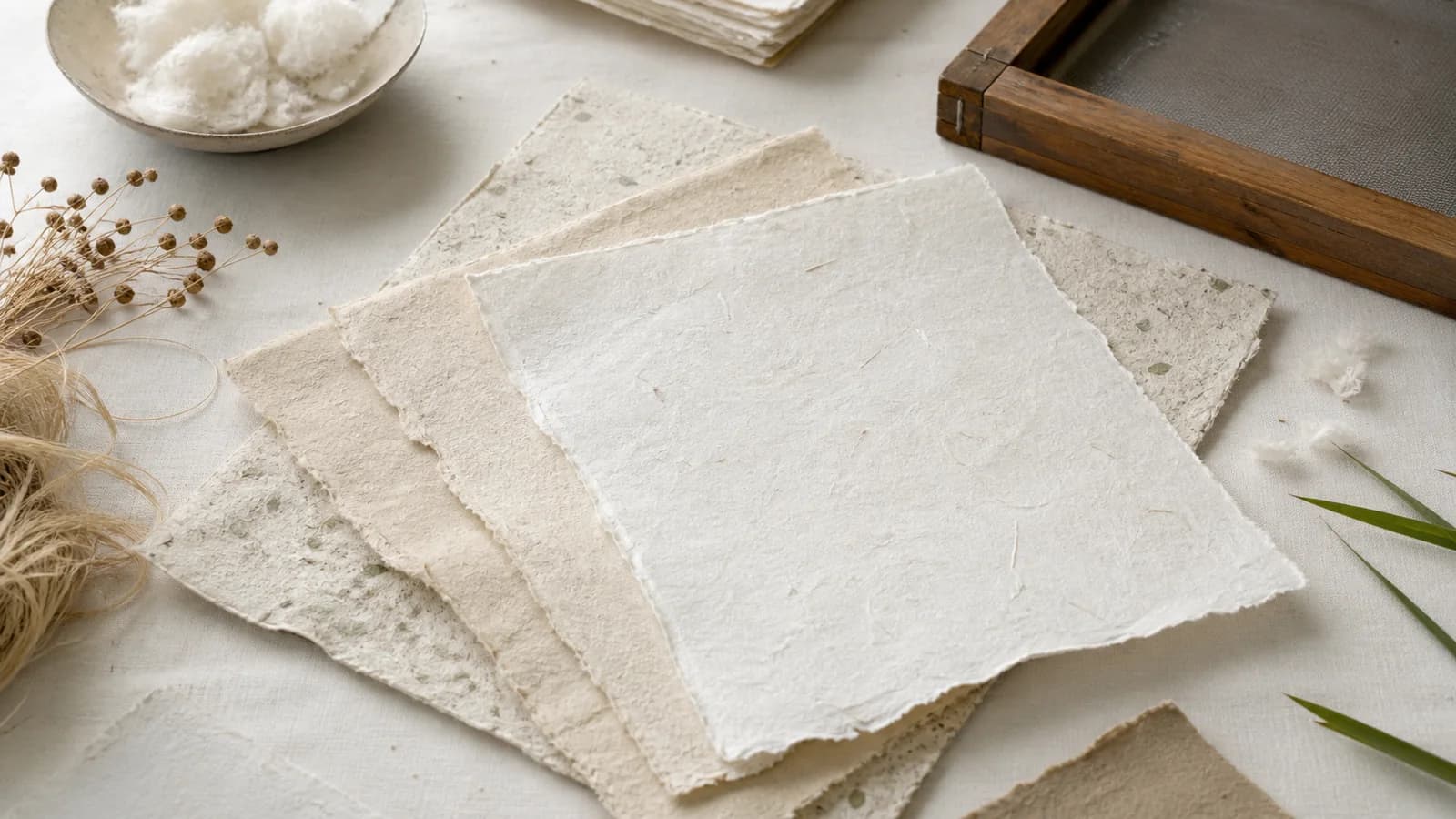
More than a surface
Paper accompanies everyday life as a carrier of writing and images, as wrapping, memory and working material. Its apparently simple surface consists of countless fibres. Fibre source, making process and finish determine whether a sheet feels soft or firm, absorbent or closed, translucent or opaque. These differences make paper a material in its own right for craft, design and art.
Paper, papyrus and parchment
The word paper derives through Latin papyrus from the Greek pápyros, but the materials differ. Papyrus is made from crossed strips of plant pith. Parchment is prepared animal skin. Paper, by contrast, forms from separated fibres dispersed in water and joined into a coherent sheet as the water drains away.
Fibres and structure
The supporting structure of paper consists mainly of cellulose fibres. Depending on origin, these may come from wood, cotton, linen, hemp, straw or recovered paper. Long, minimally damaged fibres can form a particularly strong sheet. Short fibres, fillers, pigments and sizing alter surface, opacity, colour, absorbency and printability.
From fibre to sheet
Fibres are separated, cleaned and dispersed in a large amount of water. In hand papermaking or on a paper machine they settle on a screen to form a web. Draining, pressing and drying follow. Calendering, sizing, coating or embossing may further change the surface. Handmade, mould-made and machine-made papers differ in production and sheet character.
Reading paper properties
Weight alone does not fully describe paper. Grain direction, bulk, strength, stretch, surface sizing, pH, light stability and moisture response also matter. Paper absorbs and releases atmospheric moisture, so it may cockle, expand or contract. Folds and tears often develop where fibres are repeatedly stressed or worked across their preferred direction.
History and circulation
Fibre-based papermaking developed in China more than two thousand years ago and became an important carrier of writing, imagery and cultural memory. Knowledge of its production spread over many centuries through trade, exchange and local workshops across Central Asia and regions shaped by Islamic cultures. Paper mills appeared first in parts of southern Europe and later across many other regions. Linen and cotton rags were important raw materials for a long period; industrialisation and growing demand later made wood fibre increasingly significant. Paper, printing, education and social institutions together helped make knowledge more widely accessible.
Practice voice: plants become paper
For paper artist Alina Kuster of Artisalina, paper is more than a neutral surface. Her materials include asparagus fibres, strawberry leaves and dried flowers. «By making paper, I give nature a new form», she says of her approach. Visible inclusions retain traces of their source and show how open paper remains to experiment and transformation. The quotation and attribution will be confirmed before publication.
Design and working methods
Paper can be written on, printed, painted, folded, cut, embossed, laminated, bound and shaped into three-dimensional forms. Drawing, printmaking, bookbinding, packaging, model making and paper art each require different qualities. Selection should consider tools, inks or printing methods, planned folds, handling, desired feel and longevity.
Selection, care and circular use
For long-lived work, stable fibres, suitable sizing and papers with low acidity and lignin are useful indicators. Cool, dry and stable conditions with limited light support preservation. Recovered fibres reduce demand for primary fibres and can make excellent papers for many purposes. The intended use, documented origin and efficient use of material remain decisive.
